
Single Axle vs Tandem Axle Trailer: What I Tell Customers on the Phone
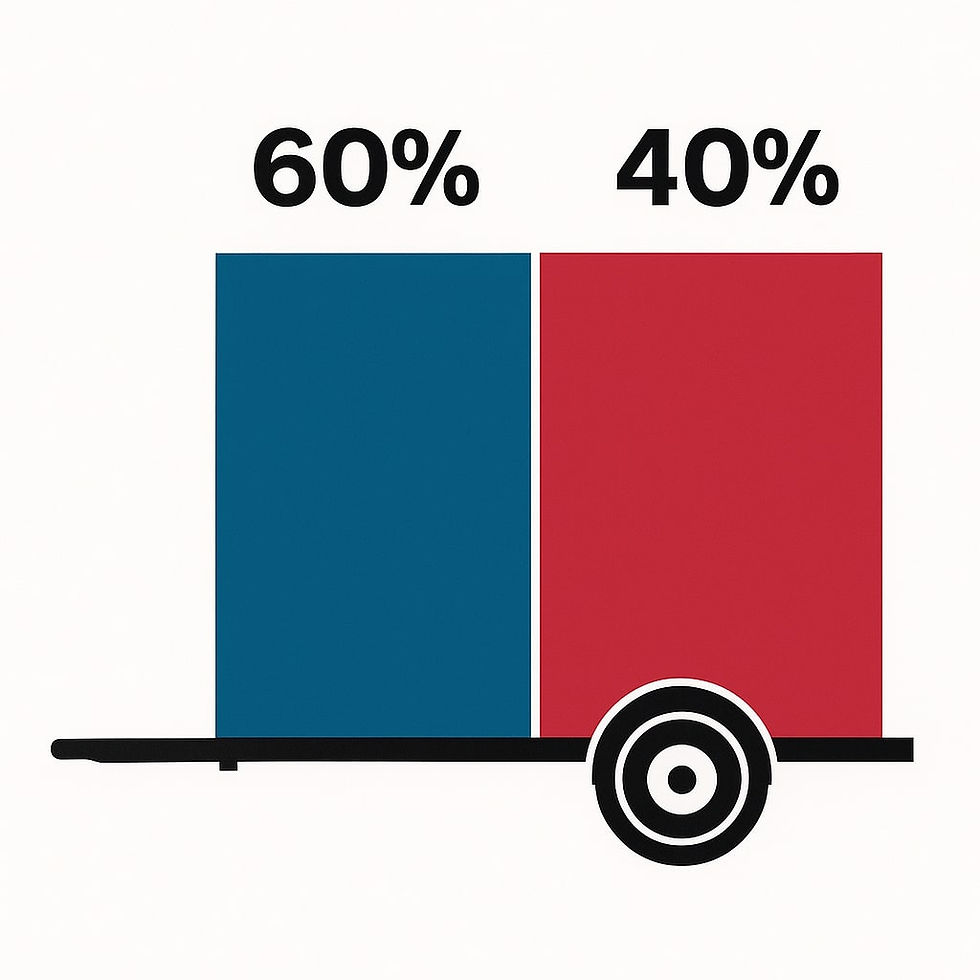
About eighty percent of the drop deck trailers we sell are tandems. The other twenty percent are singles, and almost every one of those went to a buyer who knew exactly what that trailer would haul for the next ten years.
That split tells you most of the story, but it does not settle the single axle vs tandem axle trailer question for your business. The right answer is not always buy the bigger one. I have talked customers down from a tandem, and I have watched customers outgrow a single in six months. Here is how I walk through it on the phone.

The numbers that separate one axle from two
In our lineup, a single axle drop deck trailer carries 3,500 to 5,000 pounds on a 10 foot deck, starting at $11,092. Our tandem axle drop deck trailers carry 7,000 to 10,000 pounds on decks from 10 to 16 feet, starting at $16,495.
So the tandem roughly doubles your payload and opens up longer decks. That is the obvious part. The less obvious part is what each one is actually for.
A single axle earns its keep when it has one job. A tandem earns its keep when you cannot say for certain what it will be hauling two years from now.
The ride myth that will not die
A lot of customers assume a single axle will not pull as well as a tandem. Bouncy, twitchy, white knuckles on the highway. With our HGL series that simply is not true. Every trailer in the line rides on independent suspension at each wheel, with SumoSprings on top of that. Both leading to a smooth tow.
There are two real differences you will feel:
**Backing up.** The single axle turns sharper in reverse. If you are threading into tight yards or backing off narrow streets, that agility is genuinely useful.
**A blown tire.** This is the tandem's quiet advantage. Lose a tire on a single axle and you are changing it on the shoulder, right there, right then. Lose one on a tandem and the remaining three tires let you limp to somewhere safe to get the problem resolved. For anyone running long highway miles, that alone can justify the second axle.
Tire and bearing maintenance does double with a second axle, so the tandem is not free to own. But on our trailers the patented Torsion Slide Suspension removes the extra suspension bearings, bushings, and grease points that make other tandems tedious, so the gap is smaller than it would be elsewhere.
The customer who outgrew his single in six months
Here is the pattern I warn people about. A customer runs a 19 foot scissor lift. Our HGL3510S handles that machine all day, so he buys the single. It is the economical choice, and on day one it is the correct choice.
Fast forward six months. Business is good, he picks up a larger lift, and now he owns a trailer that cannot carry his newest machine. He is back on the phone with me, and this time he buys the HGL10614, our most popular model and the biggest bang for your buck in the line. He ended up where most buyers end up. He just paid for an extra trailer to get there.
If there is any real chance your equipment gets bigger, that story is the argument for the tandem. It is something to grow into with your business.
When the single axle is the smarter buy
Now the other side, because overkill is a real way to waste money. Some buyers always want the biggest and baddest, and sometimes that instinct costs them.
Say you are an electrical contractor and you know your fleet runs 19 foot lifts, period. That is the machine, that is the job, that is the plan. Buying a quantity of single axles for your crews can be far more economical than buying tandems "just in case" a case that never comes. One dedicated machine, one right-sized trailer, multiplied across a fleet.
The single also wins in tight city work, where compact matters more than capacity, and it pairs naturally with a scissor lift trailer setup where the load never changes.

Single axle vs tandem axle trailer: the quick comparison
Compare | Single Axle | Tandem Axle |
Payload | 3,500 to 5,000 lbs | 7,000 to 10,000 lbs |
Deck lengths | 10 ft | 10, 12, 14 and 16 ft |
Models | HGL3510S, HGL5510S, HGL5610S | HGL7610 through HGL10616X |
Starting price | $11,092 | $16,495 |
Ride | Identical. Both run independent suspension at every wheel, with SumoSprings available. | |
Backing up | Turns sharper in tight yards | Wider arc |
Blown tire | Change it where you sit | Limp to safety on three |
Best for | One known machine, fleets, tight city spaces | Growing businesses, mixed loads, long highway miles |
Resale | Steady | Stronger, tandems are what buyers hunt for |
Share of what we sell | About 20% | About 80% |
Whichever you choose, load placement matters as much as axle count. Our guide to drop deck trailer weight distribution covers getting the center of gravity over the axles where it belongs.
The $5,000 question
When someone balks at the jump from a single to a tandem, I tell them the truth: you have to do what is best for your business, and you know your business better than I do.
But I also tell them what the extra money buys. A lot more trailer to grow into. A higher resale value down the road, because used tandems are what everyone is hunting for. And membership in the eighty percent, which exists for a reason.
Not sure which side you land on?
Tell us what you haul, what you might haul next, and where it all has to fit. We size trailers for a living and we will give you a straight answer, even when the straight answer is the cheaper trailer. Request a quote and let's work through it together. What is the next machine your business is going to buy?


Comments