
Tilt Trailer vs Drop Deck Trailer: Which Is Better for Equipment Loading?
One bad loading accident can cost more than the trailer you were trying to save money on.
That is the real conversation behind the tilt trailer vs drop deck trailer decision. Yes, tilt trailers are usually cheaper upfront. We understand why buyers look at them. They can work for certain equipment, certain jobs, and certain budgets.
But when you are loading low-clearance equipment, the lowest-priced option is not always the safest or smartest option.
At Drop Deck Direct, we talk with customers who haul scissor lifts, floor scrubbers, concrete saws, floor scrapers, pallet jacks, safes, ATMs, vending machines, forklifts, and other commercial equipment. Many of them have tried tilt trailers first. Some made them work. Others came back because the equipment would not climb the tilt, the tires spun, the machine bottomed out, or the operator felt unsafe.
One customer told us they tore their Achilles while trying to push a scissor lift up a tilt trailer in wet conditions.
That is exactly why this comparison matters.
The Main Difference Between a Tilt Trailer and a Drop Deck Trailer
A tilt trailer uses an angled deck to help equipment roll or drive onto the trailer. The deck tilts down, the equipment climbs the angle, and then the deck returns to transport position.
A hydraulic Drop Deck trailer works differently. The entire deck lowers completely flush to the ground using an electric hydraulic system. There are zero ramps and zero tilt angle. You load at ground level, secure the equipment, then raise the deck for transport.
That difference sounds simple.
It is not small.
When you compare a tilt deck trailer vs drop deck trailer, the biggest difference is the loading angle. A tilt trailer still requires the machine to climb. A hydraulic Drop Deck trailer removes that climb.
Where Tilt Trailers Make Sense
Tilt trailers are not useless. That would be a lazy argument.
They can be a good fit when you are hauling equipment that has enough ground clearance, enough traction, and enough power to climb the deck angle safely. They are often used for landscaping equipment, skid steers, small machinery, and general hauling.
The biggest advantage is price. Tilt trailers usually cost less than a hydraulic Drop Deck trailer.
For some buyers, that matters. If the machine handles the loading angle well and safety risk is low, a tilt trailer may get the job done.
But “can get the job done” and “best for the job” are not the same thing.
Where Tilt Trailers Start to Become a Problem
Tilt trailers become risky fast when the equipment is low, heavy, narrow, smooth-tired, or awkward to control.
This is where we see problems most often:
Scissor Lifts
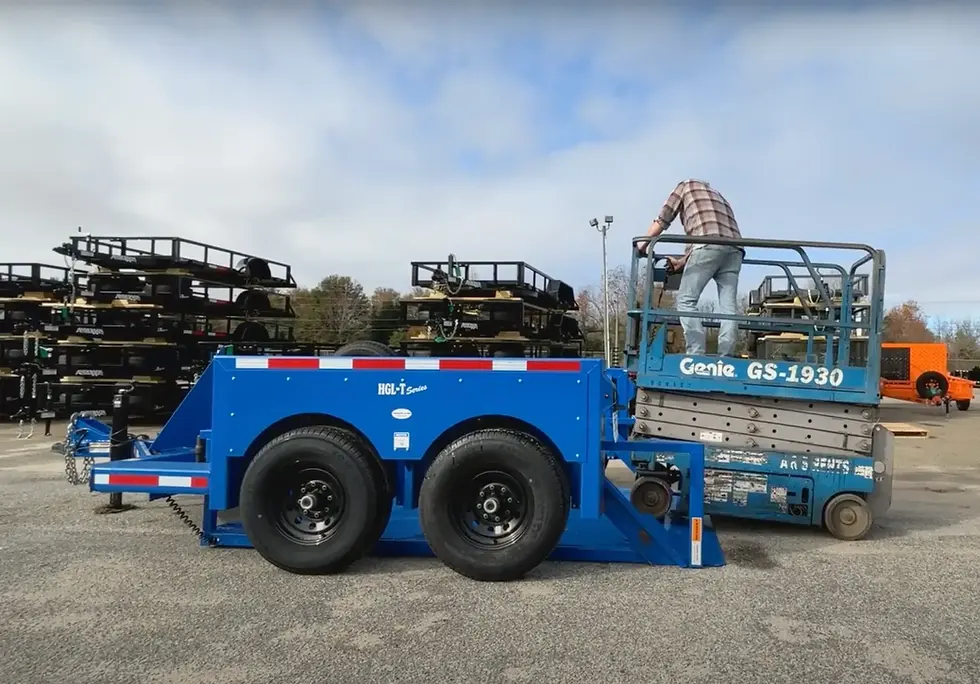
Scissor lifts are one of the biggest problem machines for tilt trailers. Many have small tires, low ground clearance, and a heavy frame. In dry, perfect conditions, some operators may get them loaded. Add rain, snow, ice, mud, or a worn tire, and the situation changes fast.
The tires can spin. The machine can slide. The bottom can drag. The operator may need someone to push or guide it, which adds even more risk.
For this type of equipment, the drop deck trailer vs tilt trailer decision usually comes down to safety.
Floor Scrubbers and Sweepers
Floor scrubbers and sweepers are not made to climb steep trailer angles. They often have low clearance, smaller wheels, and expensive components underneath.
Trying to force them up a tilt deck can lead to scraping, slipping, or getting stuck halfway up the trailer. That is frustrating on a good day and dangerous on a bad one.
Concrete Saws and Floor Scrapers
Concrete saws and floor scrapers are another tough category. They can be heavy, low to the ground, and awkward to control. Many are not designed for steep approach angles.
If the machine bottoms out, you are stuck. If it loses traction, now you have a safety problem.
Safes, ATMs, Vending Machines, and Pallet Jacks
Not everything loaded on a trailer is self-propelled.
When you are moving safes, ATMs, vending machines, or palletized equipment, a tilt trailer can create a serious challenge. You are fighting gravity, weight, and balance at the same time.
A ground level loading trailer removes that fight. You can roll or move the load onto the deck without pushing it up an angle.
Forklifts
Forklifts are another category where tilt trailers are not ideal. They are rear-heavy, have concentrated weight, and often have low clearance. That combination makes loading angle important.
For a deeper breakdown, visit our forklift trailer page.

Why a Hydraulic Drop Deck Trailer Is Safer for Low-Clearance Equipment
A hydraulic Drop Deck trailer is built to solve the loading problem at the source.
Instead of asking the equipment to climb, the trailer comes down to the equipment.
That is the whole point.
With a Drop Deck Direct trailer, the deck lowers completely flush to the ground. There are no ramps to carry, no tilt angle to fight, and no steep approach that causes machines to drag or spin. You load directly onto the deck, secure the equipment, and raise the trailer hydraulically.
That makes it a strong option for buyers looking for the best trailer for loading equipment that is low-clearance, heavy, expensive, or difficult to control.
Tilt Trailer vs Drop Deck Trailer Comparison
Feature | Tilt Trailer | Hydraulic Drop Deck Trailer |
Loading method | Angled tilt deck | Deck lowers flush to ground |
Ramps | No traditional ramps, but still angled | No ramps and no tilt |
Best for low-clearance equipment | Often not ideal | Strong fit |
Wet or slippery conditions | Higher risk | Safer loading position |
Scissor lifts | Can struggle | Strong fit |
Floor scrubbers/sweepers | Can bottom out | Strong fit |
Forklifts | Not ideal | Better loading control |
Upfront cost | Usually lower | Usually higher |
Safety advantage | Depends on equipment | Major advantage |
Best use case | General equipment with clearance | Commercial loading of low-clearance equipment |
When a Drop Deck Trailer Is Worth the Higher Upfront Cost
A hydraulic Drop Deck trailer usually costs more than a tilt trailer.
That is true.
But the better question is: what does the wrong trailer cost?
If your equipment gets stuck halfway up the tilt, you lose time. If the machine bottoms out, you may damage it. If the operator slips, falls, or gets hurt, the cost can be far higher than the difference between two trailers.
That is why safety should not be treated like a bonus feature.
It is the reason to buy the right trailer.
A trailer without ramps or tilt is especially valuable when your team loads equipment daily or weekly. The more often you load, the more loading risk matters. Small problems repeat. Small risks compound.
Recommended Drop Deck Direct Models
HGL10614: Open Deck, 10,000 Pound Payload Capacity
The HGL10614 is a strong fit for commercial buyers who need an open hydraulic Drop Deck trailer with serious capacity. It offers a 14-foot deck and a 10,000 pound payload capacity, making it a strong option for equipment like scissor lifts, floor scrubbers, concrete saws, floor scrapers, and other low-clearance machines.
If you want an open trailer that keeps loading simple and safe, this is one of the models to look at first.
HGL10614E: Enclosed Protection With Ground-Level Loading
The HGL10614E gives you the same core advantage of hydraulic ground-level loading, but with an enclosed body for weather protection and equipment security.
This is a strong option when you are hauling expensive machines, tools, or equipment that should not sit exposed to rain, snow, road debris, or job site theft.
You still get the big benefit: the deck lowers to the ground. The equipment loads without ramps or tilt.
How to Choose Between a Tilt Trailer and a Drop Deck Trailer
Use this simple test.
Choose a Tilt Trailer If:
Your equipment has plenty of ground clearance
Your machine has strong traction
You load mostly in dry, controlled conditions
Your budget is the main priority
The loading angle does not create safety concerns
Choose a Hydraulic Drop Deck Trailer If:
You haul scissor lifts, scrubbers, sweepers, floor scrapers, concrete saws, safes, ATMs, vending machines, pallet jacks, or forklifts
Your equipment is low to the ground
Your machine has small tires or limited traction
You load in wet, snowy, icy, or uneven conditions
You want safer, easier loading for your team
You want to reduce the chance of dragging, slipping, or getting stuck
Final Answer: Which Trailer Is Better?
For general equipment with enough clearance, a tilt trailer can work.
But for low-clearance commercial equipment, the answer is clear: a hydraulic Drop Deck trailer is usually the safer and better choice.
That is the honest answer to tilt trailer vs drop deck trailer.
Tilt trailers win on upfront price. Drop Deck trailers win on safer loading, better control, and fewer problems with low-clearance equipment.
If you are hauling scissor lifts, floor scrubbers, concrete saws, floor scrapers, safes, ATMs, pallet jacks, forklifts, or other equipment that does not handle a loading angle well, do not only shop by trailer price.
Shop by what happens during loading.
That is where the real risk is.
Build & Price Your Trailer
Drop Deck Direct offers hydraulic Drop Deck trailers built for safer ground-level loading. Every trailer uses an electric hydraulic system, so the deck lowers flush to the ground with zero ramps and zero tilt.
If you are comparing a tilt trailer vs drop deck trailer for your equipment, start with the loading problem first. Then choose the trailer that solves it.


Comments